
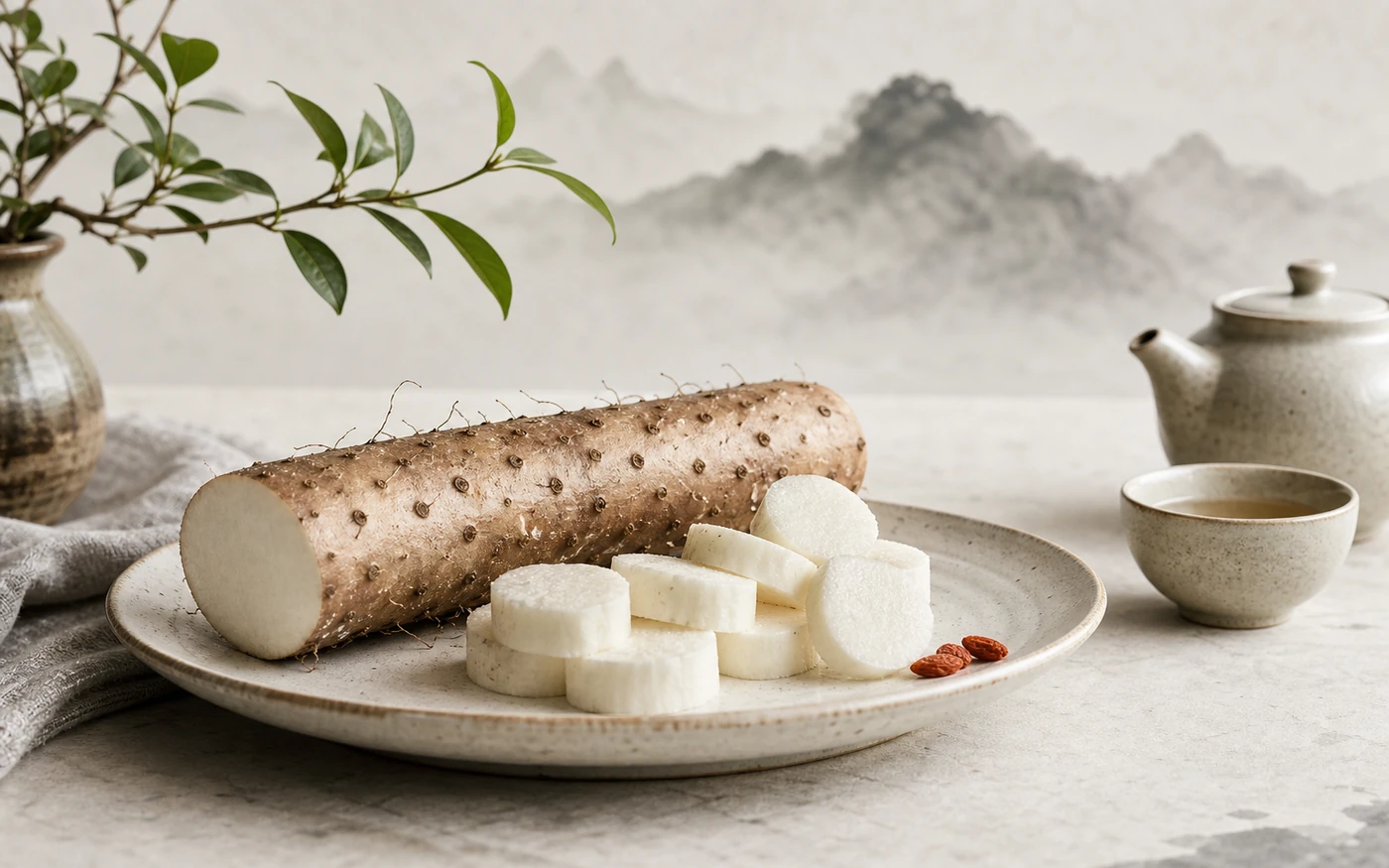
Some ingredients arrive with a long list of promises. Chinese yam is quieter.
It does not need to be turned into a supplement, a complicated tonic, or a highly specialized recipe. In many East Asian kitchens, it is simply a familiar tuber: peeled, sliced, steamed, simmered in soup, or cooked into a soft bowl of porridge.
That everyday quality is part of what makes Chinese yam an appropriate place to begin exploring Chinese food therapy. It allows us to ask a useful question:
What changes when we stop looking for a "healing food" and start paying closer attention to the qualities of an ordinary ingredient?
What Is Chinese Yam?
The plant commonly called Chinese yam is generally identified as Dioscorea polystachya. It is also associated with names such as shan yao and naga-imo, although common names and market labels can vary by country and region.
For the purposes of this article, Chinese yam refers to the edible tuber used as food.
Chinese yam sits close to the border between food and traditional herbal study. In traditional Chinese materia medica, it is commonly described as both food and materia medica, with a sweet taste and a relatively balanced thermal nature.
These terms need careful translation. In Chinese food therapy, the Spleen does not refer only to the anatomical spleen. It belongs to a broader traditional framework used to discuss digestion, transformation, nourishment, appetite, muscles, and the way food becomes usable energy.
The Lung, in the same way, is not simply the anatomical lungs. It is part of a traditional system of relationships involving breathing, the skin, fluids, and the surface of the body.
Therefore, saying that Chinese yam is traditionally associated with the Spleen or Lung systems does not mean that it has been clinically proven to treat diseases of those organs. It means that traditional writers placed the ingredient within those conceptual patterns.
What Does "Gentle" Mean?
"Gentle" is an editorial description, not a medical category.
Here, it refers to three practical qualities.
- Chinese yam can enter an ordinary meal without making that meal feel medicinal.
- Its flavor is mild enough to work with many other ingredients.
- Its traditional description is relatively balanced rather than sharply heating, cooling, bitter, or pungent.
This does not mean that Chinese yam is automatically suitable for every person, every season, or every digestive state. Chinese food therapy is not built on the idea that one ingredient has the same effect on everyone.
A food may feel comforting in one meal and heavy in another. Preparation method, portion, appetite, climate, and the rest of the plate all matter.
Chinese Yam on the Everyday Table
The easiest way to understand Chinese yam is to cook with it simply.
Depending on the variety and cooking time, it can remain lightly crisp or become soft and starchy. This gives it a place in both quick vegetable dishes and slower, more comforting meals.
Steamed
Cut Chinese yam into simple pieces and steam it until tender. It can be served beside rice, greens, eggs, fish, tofu, or another familiar protein.
In Soup
Chinese yam can be added to vegetable, chicken, mushroom, or bean-based soups. Longer cooking produces a softer texture and allows it to become part of the body of the soup rather than remaining a separate vegetable.
In Porridge
Small pieces may be cooked with rice or millet to create a soft, simple meal. The value of this type of dish is not that porridge is a universal remedy. Its value is that it can offer a warm, moist, easy-to-eat format when a person wants a quieter meal.
Lightly Cooked
Chinese yam can also be sliced and cooked more briefly with vegetables. This keeps more of its fresh, crisp character and creates a different experience from soup or porridge.
The same ingredient can therefore support different meals, not because its function changes magically, but because cooking changes texture, warmth, moisture, and the way the dish is eaten.
One Ingredient, Not a Complete Treatment
Traditional materia medica contains stronger statements about Chinese yam and includes it in medicinal combinations. Seasonal Qi does not turn those historical notes into home treatment instructions.
This article does not recommend:
- using Chinese yam to treat a diagnosed condition;
- applying raw yam to damaged or inflamed skin;
- combining it with medicinal herbs without professional guidance;
- using large or concentrated amounts as a substitute for treatment;
- assuming that tiredness, poor appetite, weight loss, or digestive symptoms all represent one TCM pattern.
An everyday food can be meaningful without being presented as a cure.
A Gentle Kitchen Practice
The next time you see Chinese yam, begin with observation rather than expectation.
Prepare it in one simple way. Then notice:
- What is its natural texture?
- Does the meal feel dry, moist, light, or substantial?
- How does the dish change when it is steamed, simmered, or cooked briefly?
- Does it belong better in a quiet meal, a soup, or a shared table?
This kind of attention is small, but it changes the relationship with food.
Safety Note
Chinese yam can cause irritation for some people when handled raw, and food allergy is possible. Anyone with known allergies, significant digestive symptoms, pregnancy-related concerns, chronic illness, or medication questions should seek appropriate professional guidance.
This article is educational. It does not provide medical diagnosis, individualized treatment, or a substitute for professional healthcare.
A Quiet Ingredient Is Still Worth Knowing
Seasonal eating does not always begin with rare herbs or complicated formulas.
Sometimes it begins with a pale root on a cutting board, a ceramic bowl, and a question about how a simple food feels in a real meal.
Chinese yam does not need to announce itself. Sometimes it simply becomes part of the meal.
Sources and Editorial Note
Traditional food-therapy framing in this article was synthesized from the Seasonal Qi internal study library and traditional Chinese materia medica teaching materials.
Botanical reference:
- NCBI Taxonomy: Dioscorea polystachya https://www.ncbi.nlm.nih.gov/Taxonomy/Browser/wwwtax.cgi?id=55575
Food-allergy safety reference:
- Xu Y-Y, Yin J. Identification of a thermal stable allergen in yam to cause anaphylaxis. Asia Pacific Allergy. 2018. https://pmc.ncbi.nlm.nih.gov/articles/PMC5796964/
The kitchen guidance and explanations of TCM terminology are Seasonal Qi editorial interpretations. Traditional descriptions are presented as historical and cultural frameworks, not as proof of modern clinical efficacy.
Seasonal Qi offers educational content inspired by traditional Chinese food therapy. It does not provide medical diagnosis, individualized treatment, or a substitute for professional healthcare.