
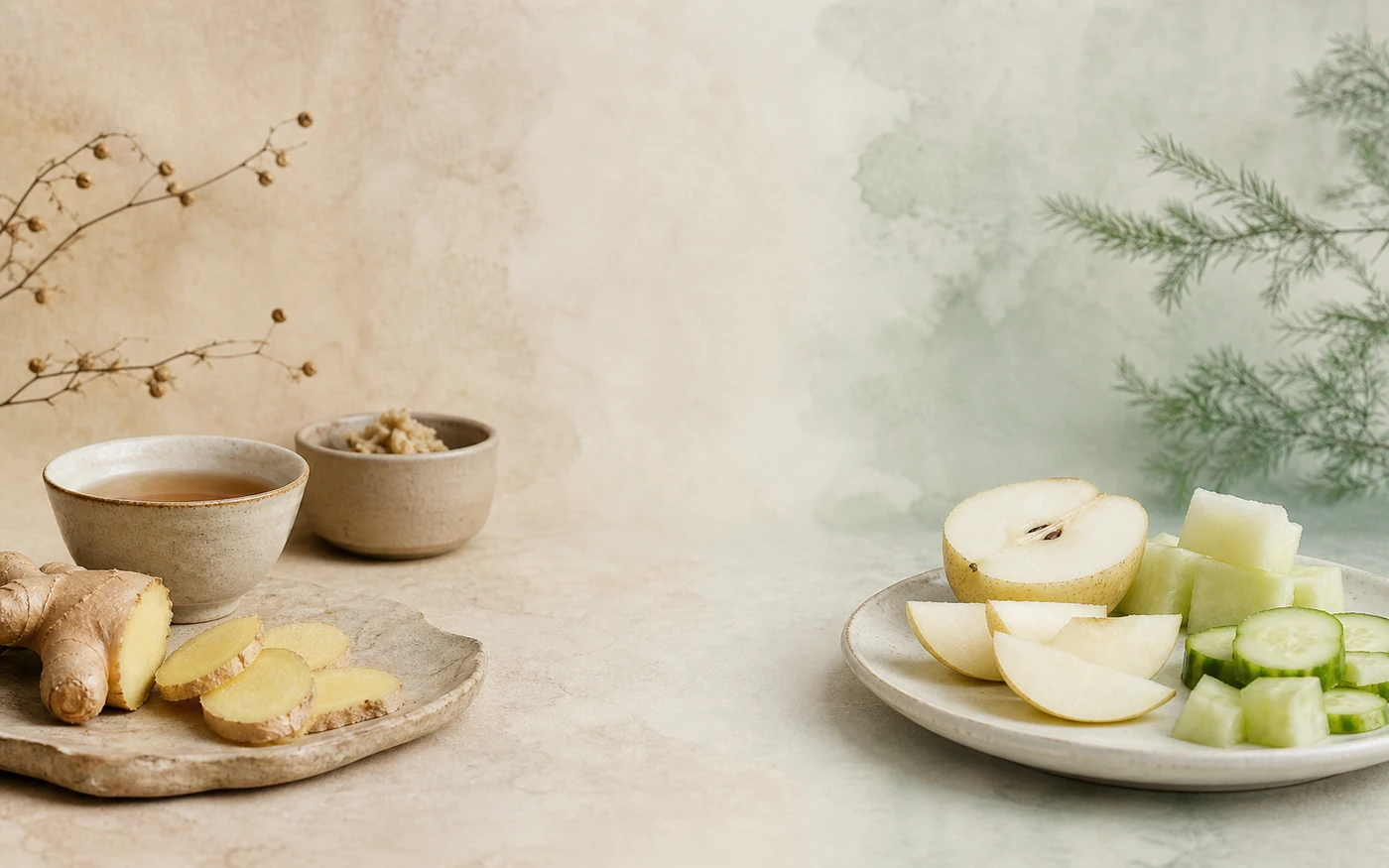
A slice of ginger may be described as warming.
A pear may be described as cooling.
But this does not simply mean that ginger must be eaten hot, or that a pear has to come straight from the refrigerator.
In Chinese food therapy, warming and cooling are traditional descriptions of how ingredients are understood within a larger system of qualities and relationships.
They are not measurements of serving temperature. They are not nutritional scores. And they are not direct translations of concepts such as inflammation, metabolism, body temperature, or immunity.
Food Has More Than One Quality
Traditional Chinese food therapy does not describe an ingredient through one label alone.
An ingredient may be discussed through:
- its thermal nature;
- its flavor;
- its texture and moisture;
- the season in which it is used;
- the way it is prepared;
- the person and context of the meal.
This is why simple lists can become misleading. A food may be called warming in one framework, but the final meal may feel light, heavy, dry, moist, sharp, sweet, or grounding depending on how it is cooked and combined.
Warming Does Not Mean Physically Hot
Hot soup may be physically hot.
Ginger may be described as warming even when it is not served at a high temperature.
These are different ideas.
In traditional food-therapy language, warming points toward a quality of movement, stimulation, or inward warmth within the framework. It does not prove a measurable medical effect, and it does not mean everyone who feels cold should eat warming foods.
Warm, Hot, Cool, Cold, and Neutral
Classical food-therapy language often uses a range of thermal qualities:
- hot;
- warm;
- neutral;
- cool;
- cold.
These words can sound simple, but they are part of a symbolic and practical system. Neutral does not mean empty or unimportant. Cool does not mean icy. Hot does not mean dangerous in every context.
The terms help describe relationship and direction rather than issuing a universal command.
Taste Matters Too
Flavor is also important.
Sweet, sour, bitter, pungent, and salty flavors are traditionally associated with different directions and systems. This does not mean that flavor alone determines what a food does. It means that traditional writers paid attention to taste as part of the total experience of the ingredient.
A pear is not only cooling. It is also sweet and moist. Ginger is not only warming. It is also pungent and aromatic.
Cooking Method Changes the Meal Experience
A raw cucumber, a quick-cooked cucumber dish, and cucumber in a warm soup are not the same eating experience.
A pear eaten fresh, gently poached, or simmered with a small amount of ginger will feel different at the table.
Cooking can change temperature, texture, aroma, moisture, and how quickly the food is eaten. In everyday seasonal eating, this may matter as much as the label.
Warming Is Not Always Better for Cold Feelings
Online food-therapy advice often turns into a shortcut:
If you feel cold, eat warming foods.
That is too simple.
Cold hands may come from room temperature, stillness, stress, circulation concerns, medication, or other health conditions. A single sensation does not establish a food-therapy pattern.
A gentle seasonal response might begin with an ordinary warm breakfast, a slower meal, or noticing whether the room is too cold. It should not jump straight to herbs, formulas, or diagnosis.
Cooling Is Not the Same as Anti-Inflammatory
Cooling foods are sometimes presented online as if they directly reduce inflammation.
That is not a responsible translation.
Cooling is a traditional descriptive term. Anti-inflammatory is a modern biomedical term that requires specific evidence, context, and measurement. The two should not be treated as interchangeable.
Seasonal Qi uses warming and cooling as cultural and culinary language, not as medical claims.
Why Simple Food Lists Can Mislead
Food lists are easy to share, but they often remove the most important part: context.
Before following a list, ask:
- What season is it?
- How is the food prepared?
- What else is on the plate?
- Is the meal satisfying?
- Does the person have persistent symptoms that need professional care?
- Is this advice being used as a rule or as a starting point for attention?
Food therapy becomes more useful when the list becomes a conversation with the meal.
A Gentle Kitchen Practice
Choose one familiar ingredient and prepare it two ways.
For example:
- cucumber fresh with a simple dressing;
- cucumber briefly cooked in a warm dish;
- pear fresh;
- pear gently poached;
- ginger in tea;
- ginger in a soup.
Notice how texture, aroma, and meal context change the experience.
The goal is not to decide whether one version is correct. The goal is to feel how food qualities become practical at the table.
What This Does Not Mean
This article does not suggest that warming or cooling foods can diagnose, treat, or reverse disease.
It does not recommend using food labels to avoid necessary medical care.
It does not recommend selecting herbs, concentrated supplements, or formulas without qualified guidance.
It does not suggest that one traditional label applies to every person in every season.
Safety Note
If you have persistent symptoms, unexplained fever, severe digestive distress, disordered eating concerns, chronic illness, pregnancy-related questions, medication interactions, or food allergy concerns, seek appropriate professional care.
Seasonal eating can support attention and routine, but it should not replace medical reasoning.
A Language for Relationship, Not a Set of Rules
Warming and cooling are most useful when they slow us down.
They invite us to notice the season, the kitchen, the cooking method, and the person eating the meal.
They are not a scoreboard. They are a vocabulary for relationship.
Sources and Editorial Note
This article draws from the Seasonal Qi internal study library and traditional Chinese food-therapy teaching materials that discuss thermal nature, flavor, preparation, and seasonal context.
The explanations of food qualities, simple cooking examples, and cautions around rigid food lists are Seasonal Qi editorial interpretations.
Traditional terminology is presented as a historical and cultural framework, not as proof of modern biomedical effects.
Seasonal Qi offers educational content inspired by traditional Chinese food therapy. It does not provide medical diagnosis, individualized treatment, or a substitute for professional healthcare.